Loading... Please wait...

Subscribe to our newsletter


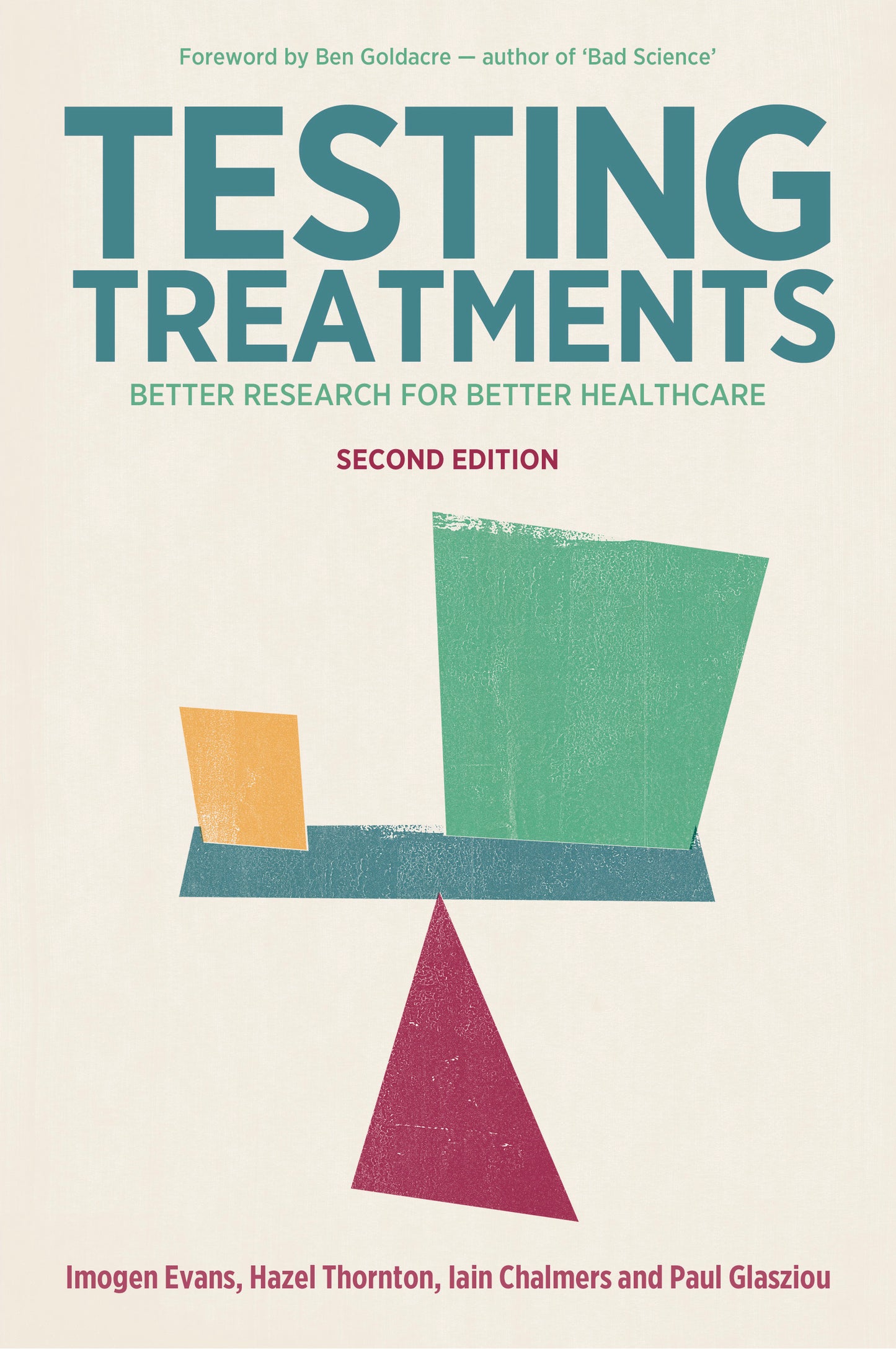
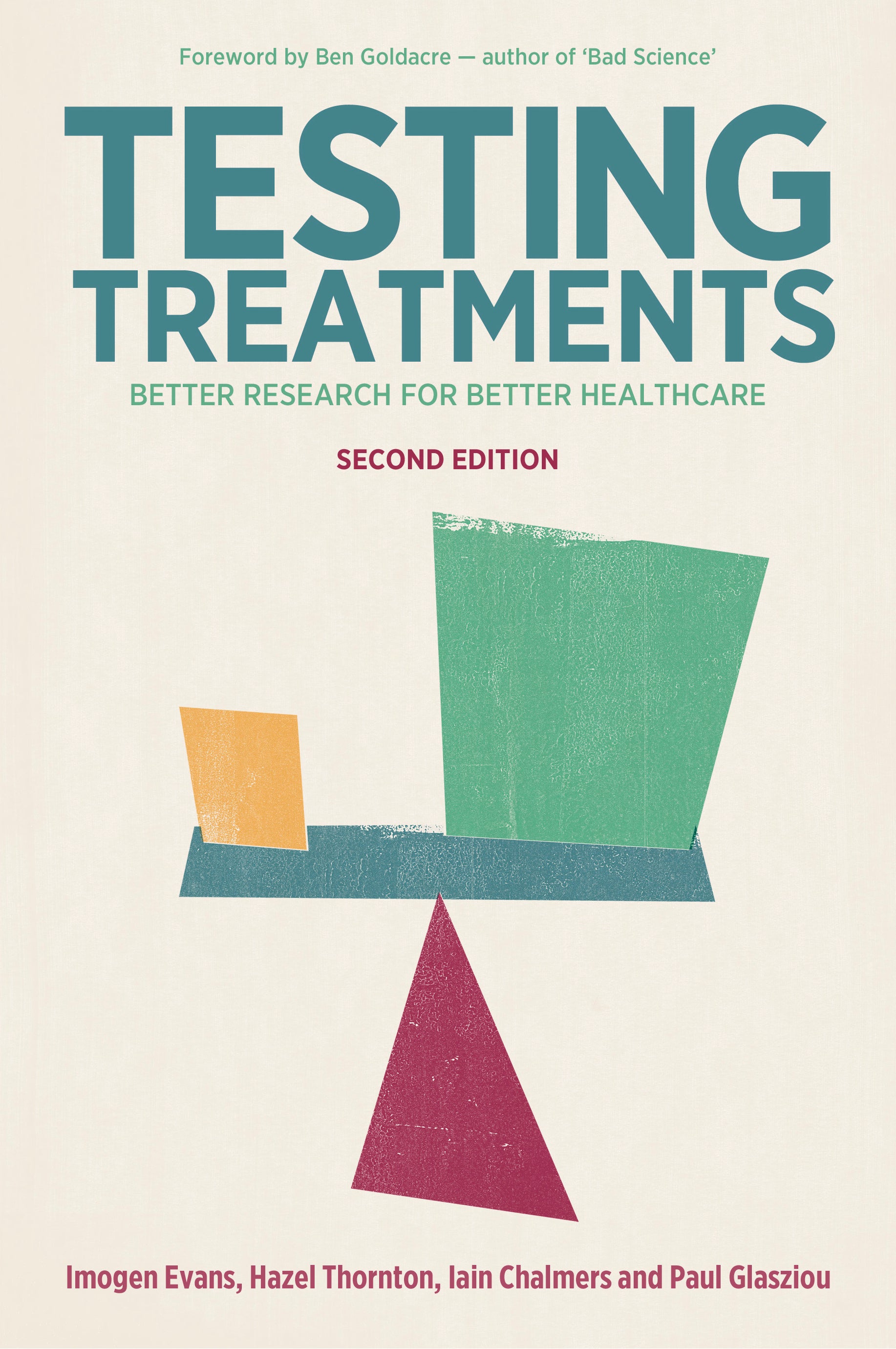
Testing Treatments: better research for better healthcare

List price:
£9.99
Your Price:
£7.99 (You save £2.00)
ISBN:
978-1-905177-48-6
Author:
Evans Thornton Chalmers Glasziou
Foreword:
Ben Goldacre
Format:
paperback
Edition:
2nd, revised edition
Published:
October 2011
Availability:
Usually despatched within 24 hours
Delivery cost:
Free Shipping
Current Stock:
100
Quantity:


About the book

How do we know whether a particular treatment really works? How reliable is the evidence? And how do we ensure that research into medical treatments best meets the needs of patients? These are just a few of the questions addressed in a lively and informative way in Testing Treatments. Brimming with vivid examples, Testing Treatments will inspire both patients and professionals.

Building on the success of the first edition, Testing Treatments has now been extensively revised and updated. The second edition includes a thought-provoking chapter on screening, explaining why early diagnosis is not always better. Other new chapters explore how over-regulation of research can work against the best interests of patients, and how robust evidence from research can be drawn together to shape the practice of healthcare in ways that allow treatment decisions to be reached jointly by patients and clinicians.

Testing Treatments urges everyone to get involved in improving current research and future treatment, and outlines practical steps that patients and doctors can take together.


Press reviews

"The best pop science book on Evidence Based Medicine ever... I genuinely, truly, cannot recommend this awesome book highly enough for its clarity, depth, and humanity." Ben Goldacre, author of Bad Science

Write your own product review

Customer reviews

Showing reviews 1-5 of 8 | Next

  1. A thought provoking read

    Posted by Amanda Denton on 6th Apr 2012

    "Testing Treatments" is a great little read, easy to pick up and understand. This book raises the awareness about the need for fair tests of treatments so that better research can help to improve the healthcare that we all, at some stage in our lives, will receive. Reading through the book it made me question how we know whether a particular drug, therapy or operation really works, and how well? "Testing Treatments" is very thought provoking read for all those interested in healthcare.


  2. Testing Treatments

    Posted by Alyson Wills on 6th Apr 2012

    A very accessible book that gives easy to grasp explanations of what can be quite complex research methods, although something is lost in the simplification of the descriptions. The book raised very interesting questions for me regarding the use of screening and its implications. As someone who works within public health it was an interesting perspective. A very useful book for anyone to read to give a greater understanding of how new treatments are evaluated and works against the inherent assumption that ‘new’ = ‘best’. The book presents a challenge to the way in which our healthcare is currently conducted. I think after reading this book it would definitely make you a more informed patient and would equip[ you with some very interesting questions to present to your healthcare practitioner. Overall a very engaging read which has encouraged me to look at the [foreword] author's other publication – ‘Bad Science’


  3. Urgent and focussed, a vital book in both senses of the word

    Posted by Jil Manning on 6th Apr 2012

    Urgent and focussed… a vital book, in both senses of the word! ‘Testing Treatments’ is a broad-ranging work, important reading for patients, tax-payers, clinicians, researchers and research funders. It is packed with evidence of unrepeated studies, unsafe results, biased results, results which aren’t properly followed up, or made available. These authors really know their subject. You will recognise many of the culprits from media reports, but still others will shock you. This book brings an awareness to consumers and patients that they are part, and can be a much bigger part, of the system by which a treatment is used and reported. Some treatments are researched, and go on sale as, ultimately, effective or ineffective drugs; others become a tragic name associated with a devastating side-effect. It gives consumers a whole raft of questions to ask, to create a mechanism whereby supply will become driven by the demand of the informed patient, rather than the will, whim or interest of the drug company. Testing Treatments is a valuable tool for anyone placing their faith in a health-shop remedy, a diagnostic procedure, or drug prescribed by a GP or consultant physician. There are a wealth of references, and the most comprehensive list of additional resources for general and specific information about current research, even about further training in the skills of assessing research evidence. Many assumptions you might have made about your GP prescribing on the basis of up-to-date research results, or that any diagnostic test must be valuable, or that the evidence of one study alone is enough, will be swept aside in this eye-opening work. There is a lot of statistical and medical information, but there are also key-points summaries, a ‘blue-print’ for a better future and an action plan of things you can do. This is a vital book, in both senses of the word…read it, you will be riveted!


  4. Testing Treatments

    Posted by Amy Pearson on 6th Apr 2012

    With my fiancé recently out of hospital this book couldn't have come at a better time really. When I received this book I thought perhaps I might not understand it as I'm not exactly very knowledgeable in the healthcare system, however it is aimed at patients as well as people with better understanding of medicine. It asks the simple questions; how do we know treatments work? how reliable is the evidence? And how do we ensure that research into medical treatments best meets the need of the patients? In the past I have had many a time where a doctor, nurse or midwife has seemed very cold towards me and has given me bad advice. However, on the whole I know NHS is understaffed, I know they work as hard as they can and I know our healthcare system is the best in, probably, the world. And yet the majority of Brits are still unhappy with the system, the professionals and the general treatments that they receive. This book hopes to resolves all of these issues. This book was fairly hard to get into and stick with as it's not usually my genre i like to read but it was still quite interesting. It's reasonably priced and is a book for anyone.


  5. Informative and entertaining

    Posted by Alicia Duffy on 6th Apr 2012

    Medical research is one of those areas where everyone thinks they know a little. Images of lab rats, miraculous cures and money grabbing pharmaceutical companies compete with the day to day reality of patients and doctors trying to tackle illness. A new edition has been published of a book that tries to shed a bit of light on to the subject. Testing Treatments is aimed at the informed patient and explains how new medical treatments are researched, and how that relates to the experience of the patient being treated. The book strikes a tone that is halfway between academic text and pop science, and might seem intimidating to some, but the regular summaries of key points and personal stories mean that the reader will soon find themselves gripped. The book takes a long view over history, covering scurvy treatments in 1747 right up to cancer trials of the present day, advocating a partnership approach between patient and doctor, and includes calls to action for professionals, patients and policy makers to ensure that questions are asked and information is shared. The reader is encouraged to look sceptically at the need for treatments and screening, and to try to see through marketing and media hype. Ben Goldacre provided the forward to this edition, and the book continues in the spirit of his work – accessible without being over simplistic. I would have liked to have more detail, but I’m not sure how that could have been achieved without losing the ease of understanding. There is an extensive list of further reading and references at the back of the book for the reader who would like to know more, and I didn’t personally feel that the scientific knowledge was shied away from in the text. Perhaps a scientist would disagree, but I went away feeling that I knew much more about the subject and that I would be a more informed patient.


Showing reviews 1-5 of 8 | Next


Find similar books by category


Add to wish list

Click the button below to add Testing Treatments: better research for better healthcare to your wish list.

You recently viewed...